Accept USDC without replacing checkout: Shopify, Stripe, and when you still need a custom stack
Most merchants asking how to accept USDC do not need a wallet, a custodian or a new checkout. They need a setting. This article explains what the native rails in Shopify and Stripe do, what they do not do, and the four cases where a custom stack is still the right answer.
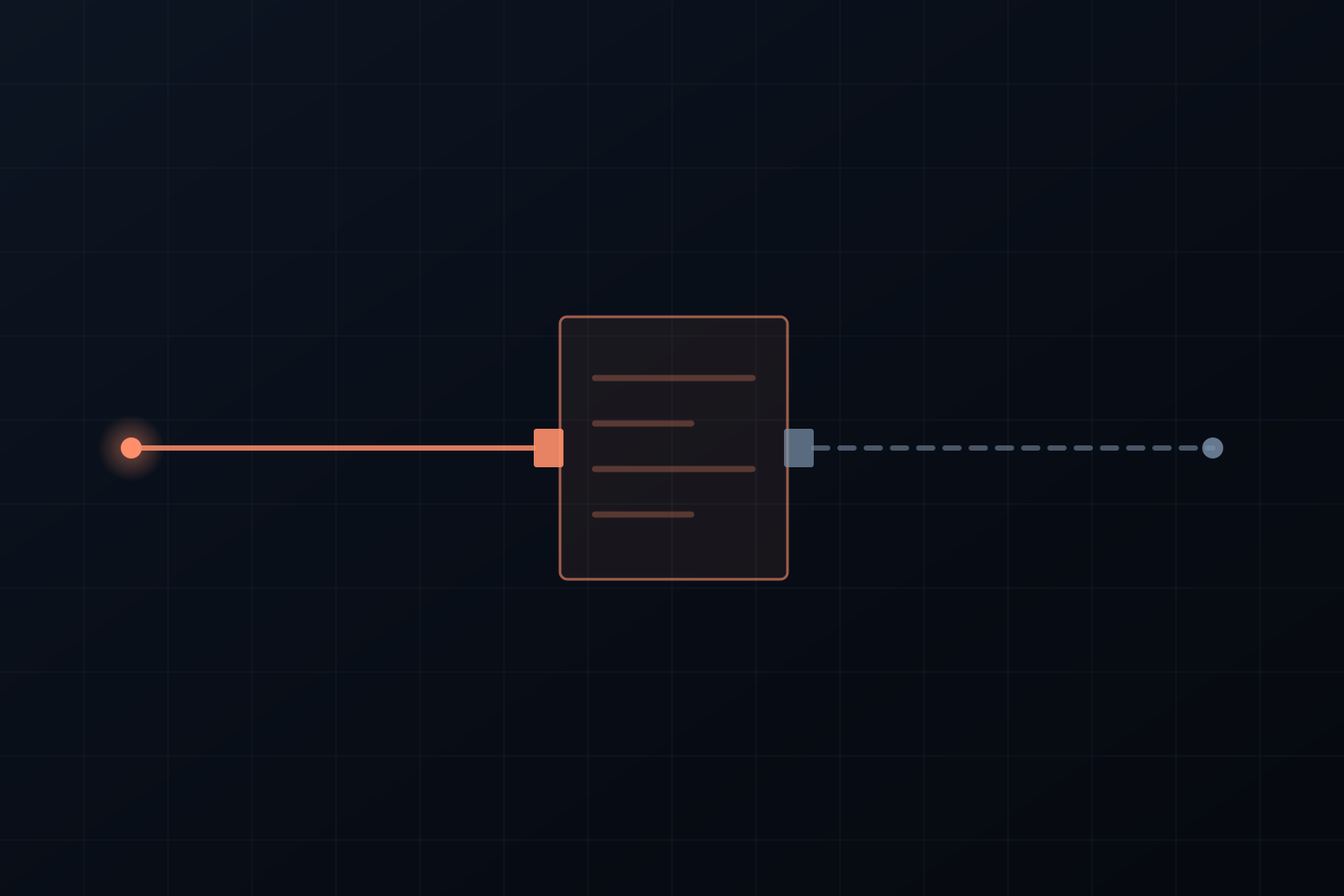
The short answer: Shopify Payments and Stripe both accept USDC at checkout and pay the merchant in local currency by default. The merchant never holds crypto, and accounting is unchanged. That covers most retail and small B2B use cases. A custom stack is only justified when treasury wants to keep USDC, when payouts as well as pay-ins need to move on-chain, when the business operates in markets the native rails do not serve, or when order values and settlement terms exceed what a checkout product is built for.
The question has changed. In 2024 a merchant asking about stablecoin acceptance was asking about an integration project. In 2026 the two largest commerce rails in the English speaking market carry USDC natively. The question is now which switch to turn on, and whether your situation is one of the few where the switch is not enough. The taxonomy behind that question is set out in pay-ins versus merchant settlement. This article is the practical version for a merchant on a mainstream platform.
Can you accept USDC on Shopify?
Yes, through Shopify Payments. Shopify announced USDC acceptance in June 2025, built on Base with Coinbase, and rolled it out to merchants in the countries where Shopify Payments operates. The design decision that matters is the default: the merchant receives the sale in local currency, converted automatically, and can opt in to receive USDC instead. Shopify built the flow to mirror card behaviour, including an authorisation step before capture, so cancellations and refunds follow the pattern a merchant already understands.
What the merchant sees is a payment method in the checkout and a settlement line in the payouts report. What the merchant does not see is a wallet, a private key, a blockchain explorer or a conversion decision at the point of sale. That is the point. The complexity is inside the platform.
Can you accept USDC with Stripe?
Yes. Stripe launched stablecoin payments in checkout in October 2024, taking USDC on Ethereum, Solana and Polygon and crediting the merchant's Stripe balance in fiat. The published fee at launch was 1.5% per transaction, below a typical card rate. Stripe then closed its acquisition of Bridge in February 2025 and in May 2025 launched Stablecoin Financial Accounts, which let a business hold and pay out in USDC across more than one hundred countries. The result is two distinct products under one brand: a checkout method that settles to fiat, and a treasury account that holds stablecoin. Merchants often conflate them. They should not. The first changes nothing in your books. The second creates a digital asset balance you must account for.
What automatic conversion means for your books
When the platform converts at the point of sale, the merchant never owns USDC. The sale is recorded in local currency, the payout arrives in local currency, and the payment method is simply another line in the reconciliation report. There is no digital asset on the balance sheet, no revaluation, no property tax treatment to consider in the United States, and no question of who holds the private keys. For a controller, this is the whole argument for the native rail. It removes stablecoins from the accounting conversation entirely.
The moment a merchant opts to receive USDC, that changes. The balance is an asset. In the United States the IRS treats digital assets as property. In the European Union the token is an e-money token under MiCA, and holding it in a third party account raises the custody and payment service questions covered in MiCA and PSD2 for stablecoin payments. None of this is a reason not to hold USDC. It is a reason to make the decision deliberately, with finance in the room.
The three paths, compared
| Dimension | Native platform rail | PSP add-on | Custom stack |
|---|---|---|---|
| Example | Shopify Payments with USDC | Stripe stablecoin checkout | Orchestration layer, custodian or self-custody, off-ramp partner |
| What you receive | Local currency by default; USDC optional | Fiat in Stripe balance; USDC via a separate account product | Whatever you design: USDC, EURC, fiat, or a mix |
| Who holds the wallet | The platform | The PSP | You or your custodian |
| Chains | Base | Ethereum, Solana, Polygon at launch | Any you choose to support |
| Payouts on-chain | No | Separate product | Yes, by design |
| Accounting change | None | None, unless you hold USDC | Digital asset accounting required |
| Integration effort | A setting | A setting or a few API lines | A project measured in months |
| Regulatory surface | Carried by the platform | Carried by the PSP | Partly yours, depending on custody model and jurisdiction |
Feature availability differs by country and changes often. Treat the platform columns as the shape of the offer, not a current feature list, and confirm with the provider before committing.
When the native rail is enough
The native rail is enough when three things are true. The business sells to customers who already hold USDC, or wants to test whether they do. Finance wants sales in local currency and does not want a digital asset on the balance sheet. And the business operates in a country where the platform offers the feature. For a retailer or a subscription business in that position, turning on USDC is a distribution test with no accounting cost. Run it, measure the share of checkout it wins, and revisit in two quarters.
A useful rule: if the reason for accepting USDC is that customers want to pay with it, use the native rail. If the reason is that the business wants to hold or move USDC, you have left the checkout conversation and entered a treasury and settlement conversation. Different product, different project.
When you still need a custom stack
Four situations justify building or buying a dedicated stablecoin stack rather than relying on the checkout rail.
- Treasury wants to keep USDC. A business paying suppliers or contractors in stablecoin has no reason to convert incoming USDC to fiat and then buy it back. That business needs a wallet or custodial account, controls over who can move funds, and a reconciliation model for a digital asset balance. The commerce rail cannot provide this because it is built to remove the asset, not to manage it.
- Payouts, not just pay-ins. Marketplaces, platforms and any business that pays out to many counterparties need a settlement rail, not an acceptance method. The checkout products do not do this. See why marketplace sellers wait five days to get paid for the payout side of the problem.
- Markets the native rails do not serve. Availability of the native features is tied to where each platform operates its payments product. A business selling into markets outside that footprint, or into soft currency markets where the buyer wants to pay in dollars, will need a provider built for those corridors.
- Order values and terms a checkout is not built for. Invoices in five and six figures, net terms, partial payments and settlement outside business hours are B2B patterns. A consumer checkout handles none of them well. A custom stack can, and it is also where instant merchant settlement becomes possible.
How to decide in one meeting
Put three people in the room: whoever owns checkout, whoever owns treasury, and whoever owns compliance. Ask two questions. Do we want to hold USDC, yes or no. Do we need to pay out in USDC, yes or no. Two noes means the native rail, and the meeting is over. Any yes means a scoping exercise, because the answer depends on custody model, jurisdiction and volume. That scoping is the kind of vendor neutral work an independent advisor does before any provider is chosen.
Common questions
Do I need a crypto wallet to accept USDC on Shopify or Stripe?
No. Both platforms hold the wallet and convert the payment to local currency before it reaches you. You receive a payout in fiat, the same as a card sale. A wallet is only required if you opt to receive USDC itself, which is a separate decision with accounting consequences.
Does accepting USDC change how I account for sales?
Not if the platform converts automatically. The sale and the payout are both in local currency, so there is no digital asset to record. If you choose to receive USDC, the balance is a digital asset, treated as property in the United States and as an e-money token in the European Union, and your accounting must reflect that.
When is a custom stablecoin stack worth the effort?
When the business wants to hold USDC, needs to pay out in stablecoin as well as accept it, sells into markets the native rails do not cover, or handles order values and payment terms a consumer checkout is not designed for. Outside those four cases, the native rail is usually the better answer.
North Settlements provides business advisory services, not legal, tax or accounting advice. Platform features, fees and country availability described here reflect public information as of September 2026 and change frequently. Confirm current terms with each provider and take qualified advice on the accounting treatment of any digital asset balance.
Not sure which path fits your stack?
We map the three options against your volume, markets and treasury policy, and tell you which one to run. Fixed fee, no vendor relationship, no software to sell.
Book an intro call